
By Brian Workman | CEO & Founder, ExhaustFlow Technologies | 28 Years in Mechanical Engineering and HVAC Design
With over 28 years working with data center chiller plants, I have walked through many facilities, reviewed thousands of performance reports, and sat across the table from operators who were frustrated, confused, and, in many cases, being sold solutions that did not address what was actually wrong.
The conversation almost always starts the same way.
The chillers are not hitting capacity. Energy costs are higher than projected. The system runs harder than it should and still cannot keep up when load peaks. The operator has already called the equipment manufacturer. The manufacturer ran diagnostics, found nothing wrong with the unit itself, and suggested adding another chiller or upgrading to a larger model.
Here is the thing. In most of those cases, the chiller is not broken. It is not undersized. It is not failing.
“The chiller is doing exactly what it is designed to do. It just is not operating in the conditions it was designed for.”
The conditions are the problem. And the conditions are being created by something most operators never think to look at: the air moving around the outside of the equipment.
The Problem Has a Name. Most People Do Not Know It.
Air recirculation. It sounds technical, but the concept is simple.
When an air-cooled chiller runs, it pulls air in through the condenser coils, extracts heat from the refrigerant, and discharges that hot air out the top. In an open field with a single chiller and unlimited space, that hot air rises and disperses. No problem.
But that is not how data center chiller plants work.
In a real data center mechanical yard, you have multiple chillers arranged in tight arrays, often in constrained footprints where space is at a premium. That hot discharge air does not have room to disperse. It rises, stalls, and gets pulled back down. It circulates. And when it does, it re-enters the condenser intake of a neighboring unit as part of its incoming airstream.
The chiller on the receiving end is now pulling in air that is significantly warmer than the actual ambient temperature. Not by a few degrees. We are talking 10 to 30 degrees Fahrenheit above ambient. That is not a rounding error. That is a fundamentally different operating environment than the one the equipment was selected and sized for.
“The chiller has no way to know the difference. It responds to what it sees. And what it sees is hot air.”
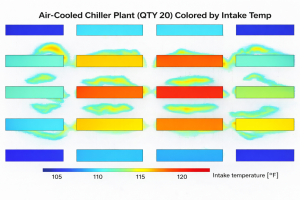
What Actually Happens to Data Center Chiller Efficiency When Inlet Temperatures Rise
This is where the performance degradation becomes real and measurable. When the condenser inlet temperatures increase, a series of costly, yet predicable events always follow.
| What Happens to the System | Measured Impact |
| Chiller cooling capacity | Drops up to 30% |
| Plant efficiency (kW/ton) | Degrades up to 20% |
| Electrical consumption | Rises to compensate for lost capacity |
| Generator and infrastructure sizing | Must increase to meet demand |
| System stability and reliability | Nuisance trips, component stress, early failures |
| Inlet air temperature vs. design | Running 10 to 30 degrees F above spec |
A chiller that was sized to handle 100% of the required load at 95 degrees Fahrenheit ambient may only be able to deliver 70% of that capacity when its inlet temperature is actually 115 to 125 degrees. That 30% capacity loss does not disappear. It shows up as a gap the system cannot close.
Operators respond by doing what makes intuitive sense: they run the equipment harder. They add more chillers. They increase electrical infrastructure. They call in service teams. They spend money.
None of it solves the underlying problem. Because the underlying problem is not the chiller. It is the air.
The Industry’s Standard Responses Are Expensive and Incomplete
Over 28 years I have seen every workaround in the book. Some of them help at the margins. None of them fix the root cause.
- Oversizing the plant: Adding more chillers
This is the most common response. If one chiller cannot keep up, add another. The logic is understandable. But if all the chillers in the array are drawing in recirculated hot air, adding one more unit means adding one more unit operating below its designed efficiency. You have more capacity on paper. The actual performance gap narrows more slowly than the investment justifies.
- Spreading out the array: Increasing equipment spacing
If you increase the space between units, you reduce the density of recirculation. It rarely eliminates it. And in most data center mechanical yards, space is exactly what operators do not have. This solution often is not available, and when it is, it comes at significant real estate cost.
- Physical modifications: Raising equipment or adding screens
There have been numerous attempts to bandaid the problem including elevating chillers, installing wind screens, or repositioning equipment in an attempt to disrupt recirculation patterns. These are field modifications with unpredictable results. They address symptoms, not causes, and they often create new airflow problems while partially solving the original one.
- Changing the cooling medium: Swapping refrigerants or adding adiabatic systems
These approaches can help efficiency at high ambient temperatures but do not address the fact that the inlet temperature is being artificially elevated by recirculation. You are managing the consequences of the problem, not the problem itself.
| THE CORE ISSUE WITH ALL OF THESE APPROACHES
Everyone has been treating the symptom which is reduced capacity and higher energy consumption. The cause is elevated inlet air temperature from recirculation. Not until you solve the inlet temperature problem will you truly fix the problem |
What the Fix Actually Looks Like
The engineering answer to recirculation is straightforward, even if it took a long time for the industry to solve it properly.
When hot discharge air is finding its way back into your condenser intake because it has no alternative place to go, the solution is competition. Bring clean ambient outside air, outside of the operating sphere of influence of your chiller bank directly to the condenser coils. Throw the recycled air out before it has a chance to be sucked back in. Make every chiller in the array behave as if it were a standalone unit operating in open air.
That is the principle behind the system we built at ExhaustFlow Technologies — learn more about our data center solutions at eflowt.com.
EFT’s patented integrated base system draws ambient air from beyond the recirculation zone and delivers it uniformly across condenser coils throughout the chiller array. Inlet temperatures stabilize at or near actual ambient conditions. The thermal interference between neighboring units is minimized. Each chiller operates in the environment it was designed for.
“When you restore design-intent inlet conditions, you restore design-intent performance. It is not complicated. It just requires solving the right problem.”
The results we see consistently across installations:
| Performance Metric | EFT System Result |
| Plant efficiency improvement | Up to 30% (kW/ton) |
| Cooling capacity increase | Up to 25% |
| Chiller input kW reduction | Up to 19% |
| Generator cost savings | Up to $29,000 per chiller |
| Equipment downtime required | None |
| Modifications to chiller internals | None required |
| Compatibility | All major chiller manufacturers |
Up to 25% increase in chiller cooling capacity. Up to 30% improvement in chiller efficiency (kW/ton). 19% reduction in chiller input kW. 20.5% reduction in MCA wire sizing requirement. 33.3% reduction in MOP breaker sizing. These are outcomes from Computational Fluid Dynamics (CFD) modeling across multiple chiller plant configurations.
Why This Matters More Right Now Than Ever Before
Data center density is increasing at a pace the industry has never seen. AI workloads require compute infrastructure that generates significantly more heat per square foot than traditional server configurations. The cooling systems being asked to manage that heat are, in many cases, the same air-cooled chiller plants that were designed for a different era of load density.
The conversation in the industry right now is dominated by liquid cooling. And liquid cooling is a real and important part of the answer for the compute side of the equation.
But here is what that conversation often misses: the chiller plant that serves the liquid cooling system still rejects heat to the outside air. And if that outside air is recirculating back into the system, the liquid cooling advantage is being partially offset by thermal degradation at the plant level.
The problem does not go away because the solution inside the building gets more sophisticated. The mechanical yard is still subject to the same physics it has always been subject to.
| THE BOTTOM LINE FOR DATA CENTER OPERATORS
Before you add a chiller, call a service team, or invest in a major infrastructure upgrade, take a look at your condenser inlet temperatures under peak load conditions. If they are running more than a few degrees above your design ambient, recirculation is likely costing you capacity and efficiency every hour the system runs. That is a problem with a direct engineering solution, and it does not require replacing what you have. |
A Final Thought
I built ExhaustFlow Technologies because I was tired of watching good equipment get blamed for a problem it did not create.
Chillers are precision-engineered machines with tight performance tolerances. When you operate them in conditions they were not designed for, they underperform. That is not a flaw. It is physics. The flaw is in how the industry has responded to the symptom instead of addressing the cause.
If your chiller plant is underperforming and you have not looked at your condenser inlet temperatures under real operating conditions, start there. The data will tell you more than any manufacturer’s diagnostic ever will.
And if what you find looks like what I have described here, I would like to have a conversation about it.
Brian Workman is the CEO and Founder of ExhaustFlow Technologies, a patented airflow management company focused on air-cooled chiller plants in data centers and high-density commercial applications. He can be reached at info@eflowt.com or through www.eflowt.com.